Back to Blogs
What We've Learned Working with 100+ Districts and Charter Networks on Responsible AI Adoption
Mara Steiu, CEO, Journify Learning
When we started building Journify Learning, we had a simple goal: help special education teachers spend less time on paperwork and more time supporting students.
Coming from a family of public school teachers, I have always believed that technology should make teachers' jobs easier, not more complicated.
But as we began working directly with special education teams, we realized that solving this challenge would require more than building another AI-powered tool.
Special education is highly individualized. Teachers are responsible for students with different strengths, needs, learning goals, and support requirements. They collaborate with other professionals, navigate complex systems, and make important instructional decisions every day.
Technology needs to fit that reality.
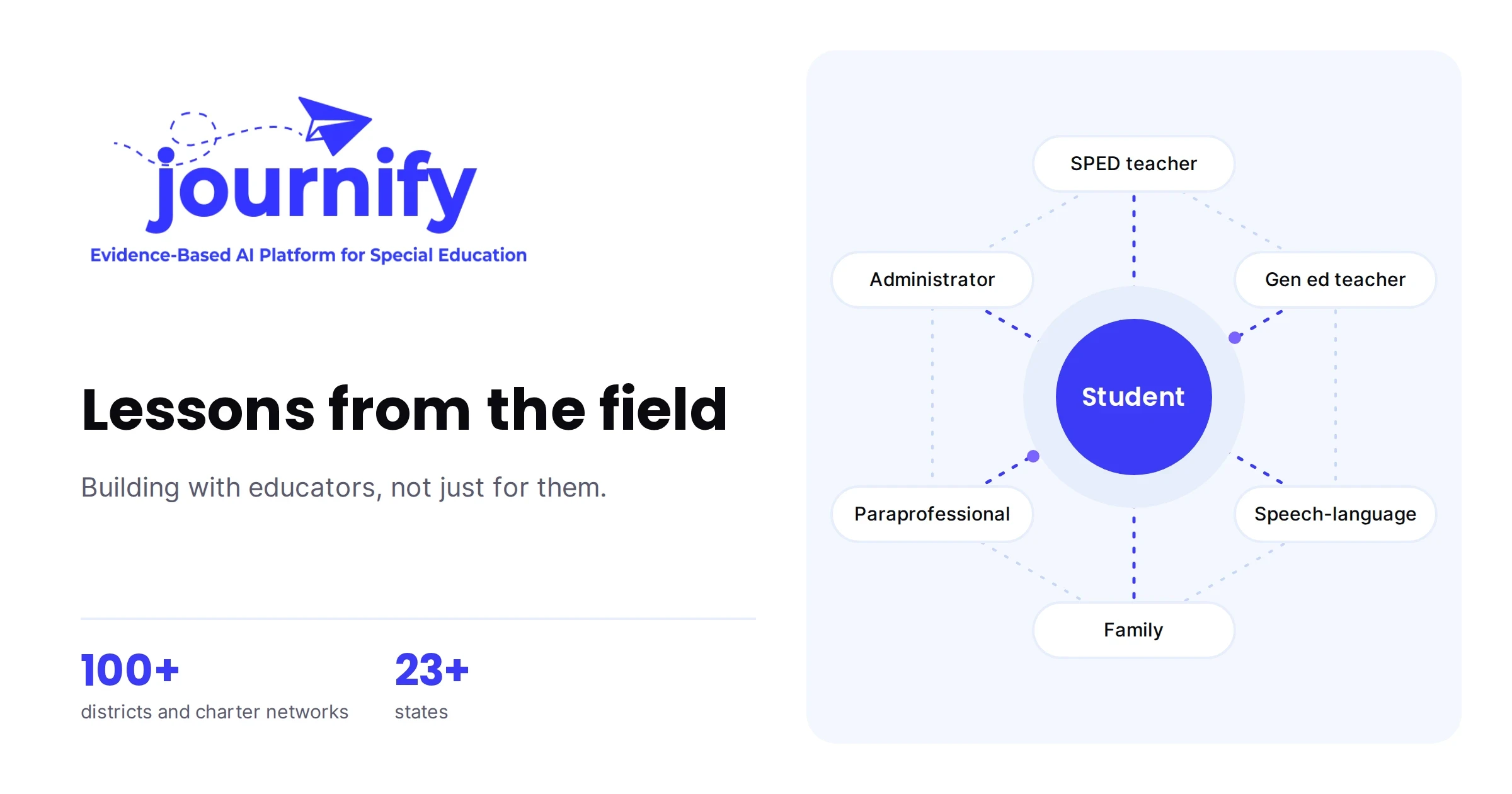
Journify has been working with more than 100 school districts and charter networks across 23+ states. Our platform is, on an ongoing basis, shaped by collaboration with educators and special education leaders. We even have an advisory board of teachers and administrators that drive product development and design on a weekly basis.
Along the way, we have learned valuable lessons about what responsible, practical AI adoption looks like in special education. Here are the ones that stand out:
Lesson 1: Start with Teachers' Real Problems, Not AI Features
One of the most important lessons we've learned is that educators rarely begin conversations by asking for artificial intelligence.
They talk about the challenges they face.
They need to prepare individualized assessments for students working toward different IEP goals.
They struggle to collect progress-monitoring evidence consistently while balancing instruction and administrative responsibilities.
They need better ways to collaborate with therapists, general education teachers, and paraprofessionals.
They want to spend less time doing repetitive paperwork, and more time with students.
This has influenced how we build Journify.
Rather than starting with a technology capability and searching for ways to apply it, we focus on the existing workflows educators find most difficult.
For example, when teachers need to develop an assessment aligned with a student's specific reading goal, we want to help them prepare an appropriate starting point quickly.
When they collect student work, we want the evidence to be easy to document and retrieve.
Our guiding principle is straightforward: The most valuable AI features are the ones that address real instructional and administrative needs.
Lesson 2: Adoption Works Better When Educators Experience Value Early
Districtwide technology adoption can be complicated, particularly when teachers are already navigating numerous tools and responsibilities.
We've learned the importance of making the first experience with a new platform practical and relevant.
That often means beginning with a smaller group of educators, understanding their priorities, and helping them solve one or two immediate challenges.
A teacher who successfully creates a goal-aligned assessment or streamlines a recurring documentation task can develop a clearer understanding of how the technology fits into their work.
That initial experience can also create opportunities for peer learning.
At Issaquah School District, for example, an educator described how interest in Journify spread organically within buildings as teachers began using the platform as part of an initial pilot.
For school leaders, this reinforces the value of educator champions and small, intentional pilots.
The goal should not simply be to introduce a tool. It should be to help a smaller yet representative and diverse cohort of educators establish useful habits that can grow over time.
Lesson 3: AI Should Work Alongside Existing Systems and Help Connect the Dots
Another important realization is that many districts do not need “yet another platform”.
They already have IEP platforms, student information systems, curriculum resources, and established processes for maintaining compliance documentation.
Asking educators to abandon those systems or enter the same information multiple times creates unnecessary friction.
We've built Journify to work alongside the tools districts already use.
Our focus is on helping teams connect relevant information and simplify the work surrounding IEP implementation, including instructional planning, assessments, progress monitoring, and collaboration. We connect the dots and bring together data across the tools that educators use.
This distinction matters.
Technology adoption becomes more sustainable when educators can improve existing workflows rather than rebuild them from scratch.
Lesson 4: Responsible AI Requires More Than a Privacy Policy
When educators work with sensitive student information, trust is essential.
But responsible AI extends beyond security documentation.
Teachers also need to understand what AI can and cannot do, how to evaluate its outputs, and when professional judgment must take precedence.
From the beginning, we've believed that educators should remain fully in control of the decisions affecting their students.
That means AI-generated content must be reviewed and edited before it is used. Teachers should be able to identify inaccuracies, make adjustments, and determine what is appropriate for each learner. We have “intentional friction” as a guiding principle within product development - we want to make sure that teachers are prompted to review and edit all outputs before they get delivered to students.
On top of that, we've embedded educator oversight into the platform and incorporated AI literacy into our onboarding and training, such that teachers understand how AI works in practice and how important their role and judgement is in the end-to-end workflows.
Our commitment to these principles helped us earn Digital Promise's Responsibly Designed AI certification.
We've also learned that responsible AI development requires continuous evaluation.
Through our partnership with Learning Commons, we are incorporating research-informed evaluators to examine aspects of generated instructional materials, such as vocabulary, grade-level appropriateness, and text complexity.
Lesson 5: Special Education Is a Team Effort and Providers’ Collaboration is Key
Although special education teachers are often at the center of IEP implementation, student support involves many professionals.
General education teachers provide essential context about classroom performance.
Speech-language pathologists, occupational therapists, and other related service providers contribute specialized expertise.
Paraprofessionals help support students throughout the school day.
Administrators need visibility into the quality and consistency of implementation.
And families bring knowledge of students that extends beyond what can be captured in school records.
We've learned that technology is most useful when it recognizes these interconnected roles.
A platform focused only on making one teacher's documentation faster may provide meaningful value.
But connecting evidence and supporting collaboration across the educational team creates additional opportunities for coordinated support.
This is why we've continued expanding Journify beyond individual assessment generation to include progress monitoring, shared documentation, reporting, and collaboration.
The goal is to help educators develop a more complete understanding of each student, together.
Lesson 6: Evidence Matters More Than the Excitement Around AI
The education technology industry moves quickly.
New AI capabilities are introduced almost every week, often accompanied by ambitious promises about transforming education.
But school districts need more than compelling demonstrations.
They need to understand whether tools are grounded in research, designed responsibly, and effective in the environments where they are used.
Our team has been fortunate to receive recognition through the 2025 Tools Competition, the 2026 ASU+GSV Cup 50, and Digital Promise's Research-Based ESSA and Responsible AI certifications.
These milestones have been encouraging.
But they are not the finish line.
We're continuing to invest in research, including work with Stanford researchers to better understand educator workload, collaboration, and the implementation of student supports.
Our aim is to build a stronger evidence base over time and remain transparent about what we know, what we are still learning, and where further evaluation is needed.
That commitment is especially important in special education, where technology must ultimately serve the needs of students and the professionals supporting them.
Looking Ahead: Building AI with Educators, Not Just for Them
Working with special education teams across the country has reinforced something I believed when we started Journify: educators are not looking for technology to replace their expertise.
They want tools that make it easier to use that expertise.
They want to spend more time delivering instruction, understanding student progress, and collaborating with their colleagues.
They want solutions they can trust.
And they want technology that recognizes the complexity and importance of their work.
As AI continues to evolve, I believe the most successful educational tools will be those built in close partnership with educators, grounded in research, and evaluated based on the real value they create.
For us, that means continuing to listen, learn, test, and improve alongside the schools and districts that place their trust in us.